Appendix
Augmented Instruments: Between Tradition and the Digital Realm
The relationship between performance practice and digital technology should not be understood as a rupture with the past, but rather as a progressive transformation that redefines—without negating—the role of the acoustic instrument, bodily gesture, and the relationship between performer and sound. This appendix examines four dimensions of this transformation: the theoretical concept of the augmented instrument, the evolution of the MIDI protocol toward new levels of expressivity, the Antescofo system as a paradigm of real-time interaction, and the aesthetic reflection that accompanies and informs these practices.
A. The Augmented Instrument: Tradition Enhanced by Digital Technology
The concept of the augmented instrument is grounded in the conviction that digital technology should not replace the acoustic instrument but rather extend its operational possibilities while preserving its organological identity. The approach developed at the IRCAM in Paris is exemplary in this regard: the traditional instrument—with its technique, timbre, and physicality—remains at the center of the musical process, while digital electronics intervene by adding layers of processing that expand what the instrument can do without replacing what it is.
In practical terms, this involves analyzing sound in real time, transforming it through delays, harmonizers, and filters, establishing a dialogue between performer and system—up to forms of AI-assisted improvisation—and adding sonic dimensions that the acoustic instrument alone could not produce. In all these cases, the direction remains the same: not something new in place of the instrument, but the traditional instrument enhanced through digital means.
The MIDI guitar represents an emblematic example of this principle. It remains, first and foremost, a guitar: it continues to produce its own acoustic sound, which may be captured either through an external microphone—as it is a fully acoustic instrument—or through its internal piezoelectric pickup. The audio layer of the instrument, with its timbre and physical presence, is never removed. The true innovation introduced by MIDI does not lie in replacing that sound but in an additional capability: the possibility of assigning each of the six strings to an independent channel, thereby generating separate streams of digital data. This channel-based division greatly expands the expressive and timbral potential of the instrument—allowing note-by-note control—without compromising its organological integrity. The guitar remains itself, and it is precisely upon this intact acoustic foundation that digital technology introduces a new degree of freedom.
This principle constitutes the guiding thread of the entire appendix and underlies both the evolution of communication protocols and the development of score-following systems, as well as recent aesthetic reflections on digital performance practice.
B. From MIDI 1.0 to MIDI 2.0: Toward Enhanced Expressivity
Introduced in 1983, the MIDI protocol served for four decades as the lingua franca of communication among electronic instruments, computers, and digital processing systems. Its simplicity—128 velocity levels, 16 channels, and unidirectional messaging—ensured its longevity, but it also imposed significant limitations on the ability to translate the expressive richness of instrumental gesture into digital data.
The transition to MIDI 2.0, together with the introduction of MPE (MIDI Polyphonic Expression), represents a profound qualitative leap. Resolution increases from 7-bit to 32-bit precision—from 128 values to more than four billion—making system response effectively continuous and much closer to the fluidity of acoustic performance. Communication becomes bidirectional: devices no longer merely receive instructions but communicate with one another, self-configure through Profile Configuration, and exchange information through Property Exchange. Timing becomes more accurate, dynamics smoother, and responsiveness to analog controllers and physical gestures substantially improved.
MPE, in particular, enables expressive parameters such as pitch bend, vibrato, and pressure to be applied independently to each individual note, overcoming the limitations of MIDI 1.0, where such parameters affected an entire channel. For an instrument such as the hexaphonic guitar, in which each string generates an autonomous signal, this means that the full complexity of performance gesture can be transmitted with far greater precision. With native integration into Windows 11 expected in 2026 and increasing support among major digital audio workstations, MIDI 2.0 is emerging as the infrastructure upon which the next generation of augmented instruments will be built.
The essential point, in relation to the central argument of this appendix, is that MIDI 2.0 does not alter the nature of the relationship between performer and instrument; rather, it strengthens it. The gesture remains the gesture, but its digital translation becomes more faithful, richer, and more expressive.
C. Antescofo: The System That Listens and Anticipates
If MIDI 2.0 addresses the problem of gesture transmission, Antescofo tackles a different and, in some respects, more complex question: how can an electronic system follow a musician in real time, adapting to fluctuations in tempo, dynamics, and interpretation?
Developed by Arshia Cont at IRCAM beginning in 2007, Antescofo is a score-following system capable of identifying a performer’s position within a score directly from live audio input and synchronizing electronic processes accordingly. Yet the most significant characteristic of Antescofo is not its capacity to follow but its ability to anticipate. The system analyzes the trajectory of a performance and can predict upcoming musical events, transforming itself from a mere accompanist into a genuine musical partner capable of adapting proactively to the performer.
Among its most celebrated applications are Anthèmes 2 by Pierre Boulez for violin and electronics, the automated-orchestra realization of Ravel’s Concerto for the Left Hand, and numerous works by Philippe Manoury and Marco Stroppa. In all these cases, Antescofo manages synchronization between acoustic instrumental performance and live electronics, ensuring a degree of temporal coherence that no manually triggered system could achieve.
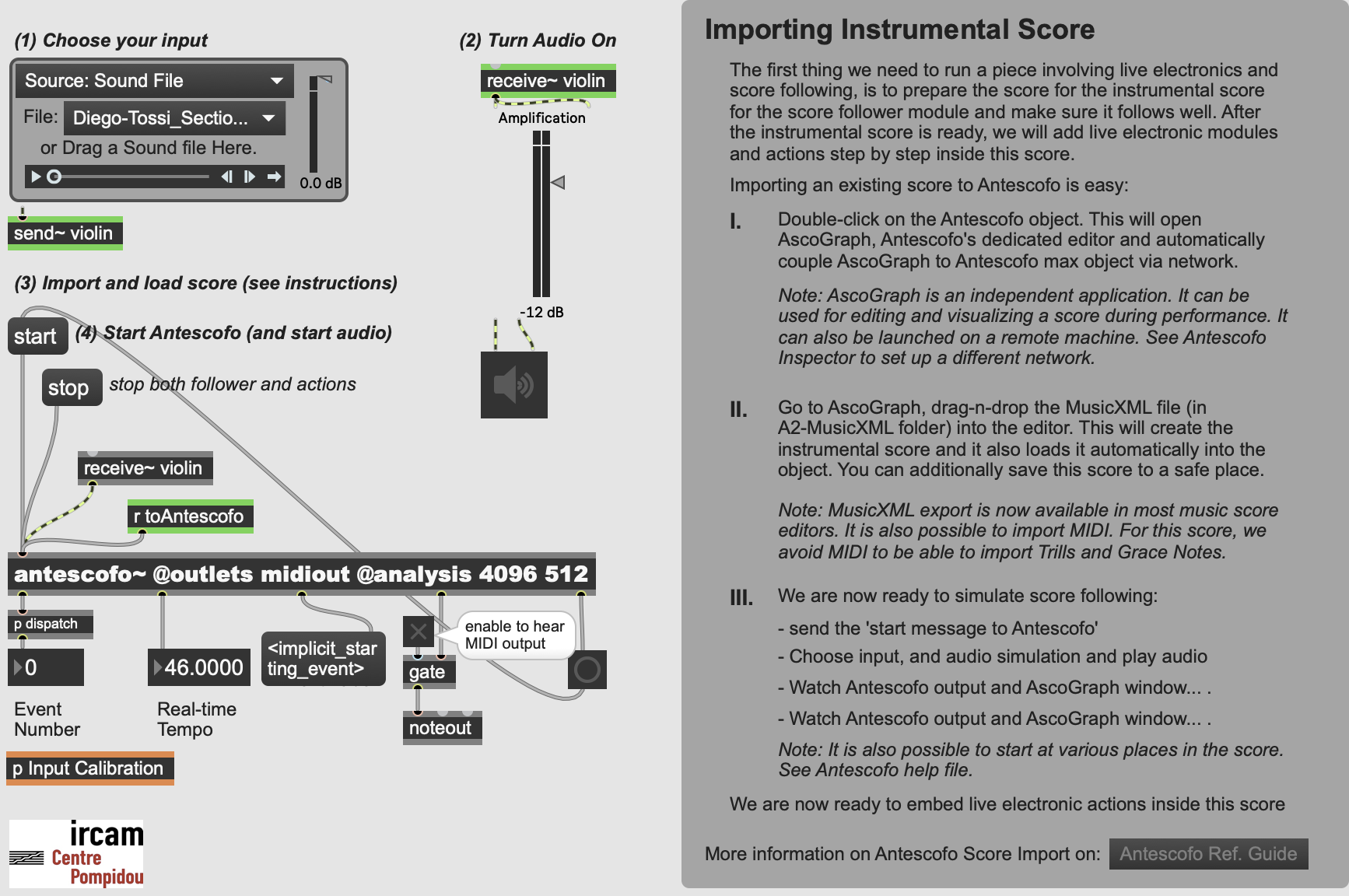
Interface Antescofo in MaxMSP (protocollo
MusicXML / MIDI)
In the context of the augmented instrument, Antescofo represents perhaps the most compelling limiting case. It does not merely transform instrumental sound; it constructs around the performer a reactive and intelligent sonic environment capable of responding in real time to interpretative choices. The acoustic instrument remains at the center, but the electronic system becomes an interlocutor rather than a simple processor.
D. The Aesthetics of Digital Performance Practice
The theoretical framework that most effectively encompasses these transformations has been developed by Thor Magnusson, particularly in Sonic Writing (2019) and in his essay “A Theory of Digital Musical Instruments,” published in The Oxford Handbook of Algorithmic Music.
The central premise of Magnusson’s perspective is that the technological evolution of musical instruments proceeds through layers of adaptation and incremental enhancement rather than through absolute ruptures. The history of musical instruments is a history of successive augmentations—the addition of keys to the harpsichord, the sustain pedal to the piano, amplification to the guitar—and the introduction of digital electronics follows this same logic, albeit representing a leap in complexity without historical precedent. Organological continuity remains fundamental: even in the most advanced systems, gesture, technique, and the physicality of the acoustic instrument continue to serve as primary points of reference.
Within this framework, instruments such as the MIDI guitar, the MIDI-controlled Disklavier, and live-electronics systems do not eliminate the traditional instrument; rather, they expand its operational possibilities through algorithms, sensors, and computational processes. The instrument becomes a hybrid system in which the electronic component functions as an extension of instrumental gesture rather than its negation.
The true philosophical novelty therefore lies not in abandoning the historical instrument but in redefining the relationship among body, interface, and sound. Electronics introduce new layers of mediation—protocols, algorithms, latency, and feedback—while maintaining the performer and performance practice at the center of the musical process. The performer does not disappear behind technology; rather, technology is inhabited, embodied, and transformed into expression through performance.
The four themes explored in this appendix converge toward a common conclusion: digital technology has not produced a rupture with performance tradition but rather a profound transformation in the ways that tradition is practiced and transmitted. The augmented instrument—in its MIDI implementations, score-following systems, and advanced communication protocols—is not the end of the acoustic instrument but its continuation through other means.
What remains unchanged throughout these transformations is the primacy of gesture: the hand on the string, the control of sound, and the interpretative decision. Technology amplifies, mediates, and responds—but the musical act remains fundamentally a human act.
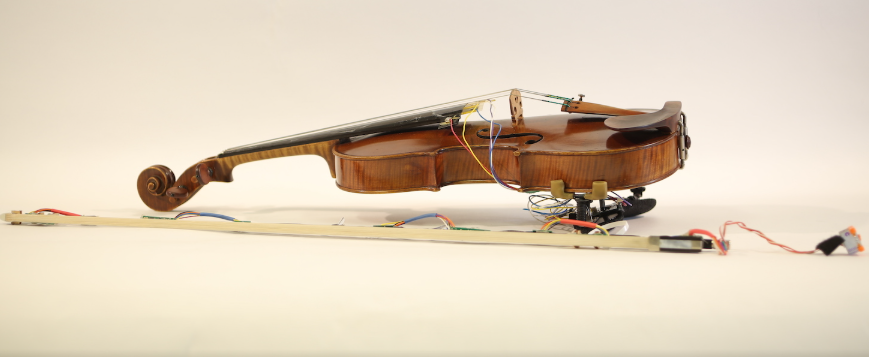
Violin and digital devices IRCAM
link ->
Violin Gesture Sensing
link ->
ipercello - ipercello