Stefano Petrarca - Il
giardino di Goldbach (2026)
per chitarra e live electronics
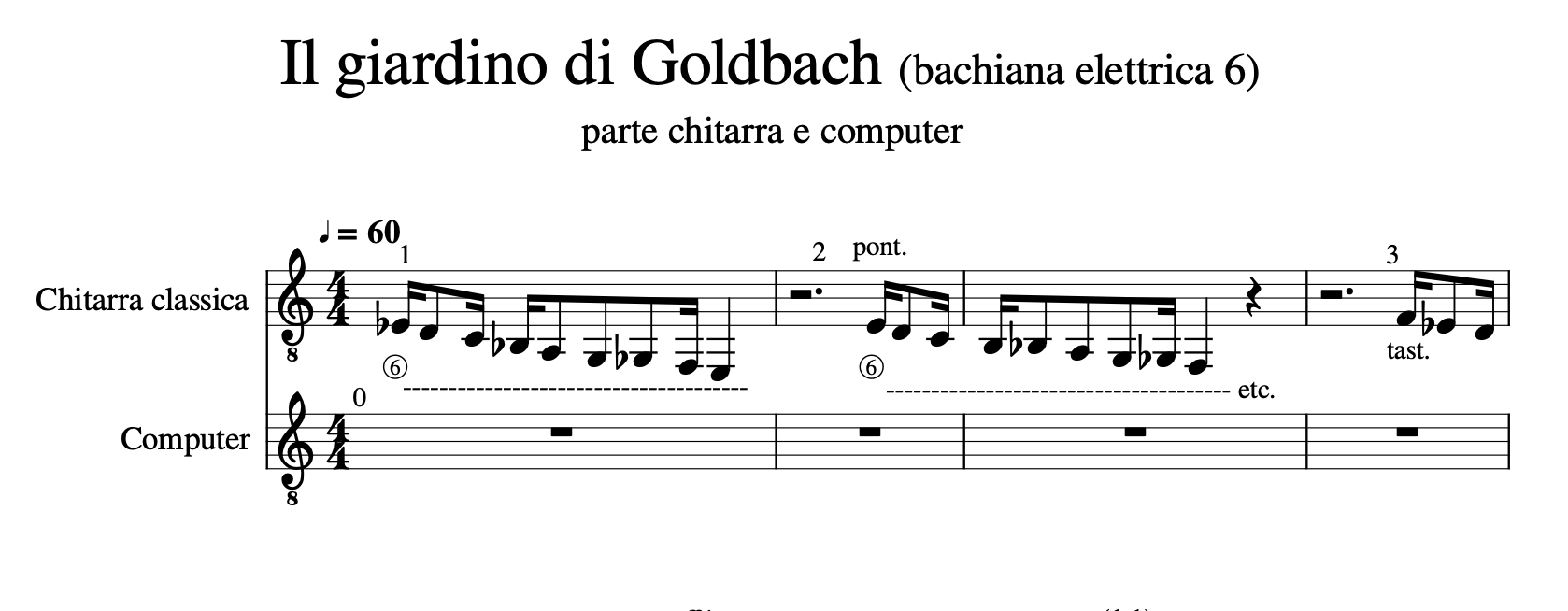
incipit
Stefano Petrarca - Il
giardino di Goldbach (2026)
Performance Notes
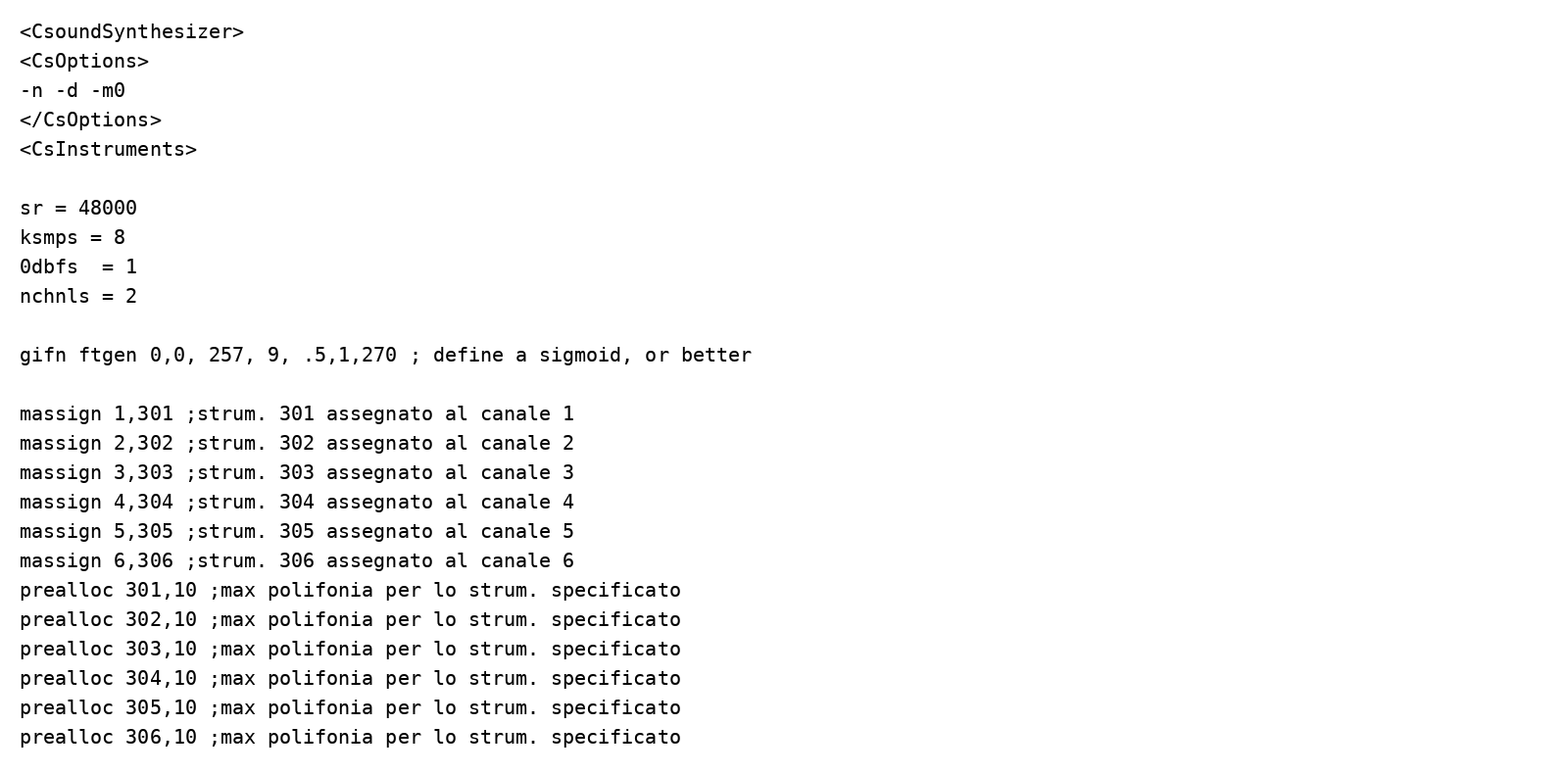
This work belongs to my Electric Bachianas collection, currently consisting of eight pieces (five of which, including the present one, have been completed, although the collection is not yet considered definitive). All the works are based on musical materials drawn from the Bach repertoire. In particular, subjects and countersubjects, including all their mirror forms, have been derived from the first fugue of The Musical Offering (the so-called Thema Regium) and from Contrapunctus I of The Art of Fugue. The title of the collection is an explicit reference to Heitor Villa-Lobos’s celebrated Bachianas Brasileiras. The present work, Bachiana 6, is the sixth piece in the collection and takes the Thema Regium as its source material. This basic sequence is elaborated through mathematical proliferation procedures that generate sets of pitches, durations, and “effects” (see below), which are employed in various ways throughout the piece. One example is the opening phrase, which is repeated with slight variations at progressively increasing temporal distances. From a structural perspective, the generated sequences are organized into what I call “slots”: temporal windows within which musical events take place. These slots are constructed around pairs of prime numbers that indicate, respectively, the sequence governing the slot and the number of events it contains (a form of horizontal density). Each slot may contain from one to three groups, functioning as a kind of sub-slot. The recurring phrases (four phrases repeated in different ways thirteen times, each time with different effects before returning to the first) are characterized by timbral modifications that I have simply termed “effects.” The first six effects are acoustic in nature and are performed directly by the guitarist, whereas the remaining seven are electronic and are executed by the computer. The work was composed for Maestro Francesco Cuoghi and his MIDI guitar, that is, a classical acoustic guitar equipped with electronic systems capable of converting performed notes into MIDI data. For the realization of the effects, I exploited a characteristic of the instrument whereby each string is assigned to a different MIDI channel: the first string transmits on channel 1, the second on channel 2, and so on up to channel 6. (S.P.)
Incipit istruzioni .csd per
csound~
 Registration-->
Soundclud o link -->
Registration-->
Soundclud o link -->
https://soundcloud.com/user-748564679/reg-ph-mix1?si=5a93998ff3d0487faec30786d5479344&utm_source=clipboard&utm_medium=text&utm_campaign=social_sharing