The Repertoire: An
Evolving Ecosystem
Discussing the repertoire for MIDI guitar means, first and foremost, discussing composition and musical writing—an indispensable point of departure. The MIDI guitar is not simply a traditional instrument enhanced by technology; rather, it constitutes a new compositional subject that redefines the relationship between performer, score, and sound processing. Every work within this repertoire entails fundamental decisions regarding the location of sound: within the body of the guitar, within the machine, within the algorithm, or within the network of relationships connecting these elements.
Before addressing the repertoire itself, it is useful to recall a number of experiences that either preceded or paralleled the emergence of the MIDI guitar in the strict sense, helping to clarify its aesthetic and technological context. Pat Metheny did not employ a MIDI guitar per se; however, his engagement with synthesis—most notably exemplified in the album Offramp (1982)—demonstrated how the guitar could already interact with synthetic sound worlds, seeking timbres unattainable through strings alone. Even more directly, John McLaughlin explored the Roland G-303 hexaphonic pickup system, integrating it into an improvisational language that fused the voice of the guitar with that of the synthesizer. This was not a replacement of the instrumental sound, but rather a genuine timbral integration. Equally significant is the work of guitarist Nick Didkovsky [ https://didkovsky.com/ ] who combined the instrument with algorithmic composition through a variety of software environments and Java-based programming languages.
It should be noted, however, that these examples belong primarily to the domain of the electric guitar and emerge from stylistic contexts quite distinct from that of the classical guitar, which constitutes the principal focus of this chapter.
Repertoire with Dedicated Devices
The earliest compositional experiences involving the MIDI guitar developed through dedicated hardware devices—expanders, multitimbral modules, and hardware synthesizers—which became genuine interlocutors of the instrument. Within this context, special mention should be made of Arnaud Dumond, undoubtedly among the earliest pioneers of the classical MIDI guitar. Beginning in 1992, in collaboration with Francis Faber, he developed a systematic compositional approach to the instrument.
Representative works from this period include Tres fragmentos by José Augusto Mannis (1992) and the compositions of Maurizio Pisati, which explore the timbral possibilities offered by the synthesizers of the time as organic extensions of the guitar’s voice.
In the American context, Tod Machover’s Bug-Mudra (1990) represents a particularly significant case. Here, the guitar is integrated into a hyperinstrument system in which the performer’s gestures generate real-time sound transformations, anticipating issues that would become central during the following decade. The defining characteristic of this first phase is the attraction—and at the same time the challenge—of unprecedented synthetic timbres that could not be produced acoustically by the traditional guitar but became accessible through MIDI conversion, thereby opening a radically new aesthetic space.
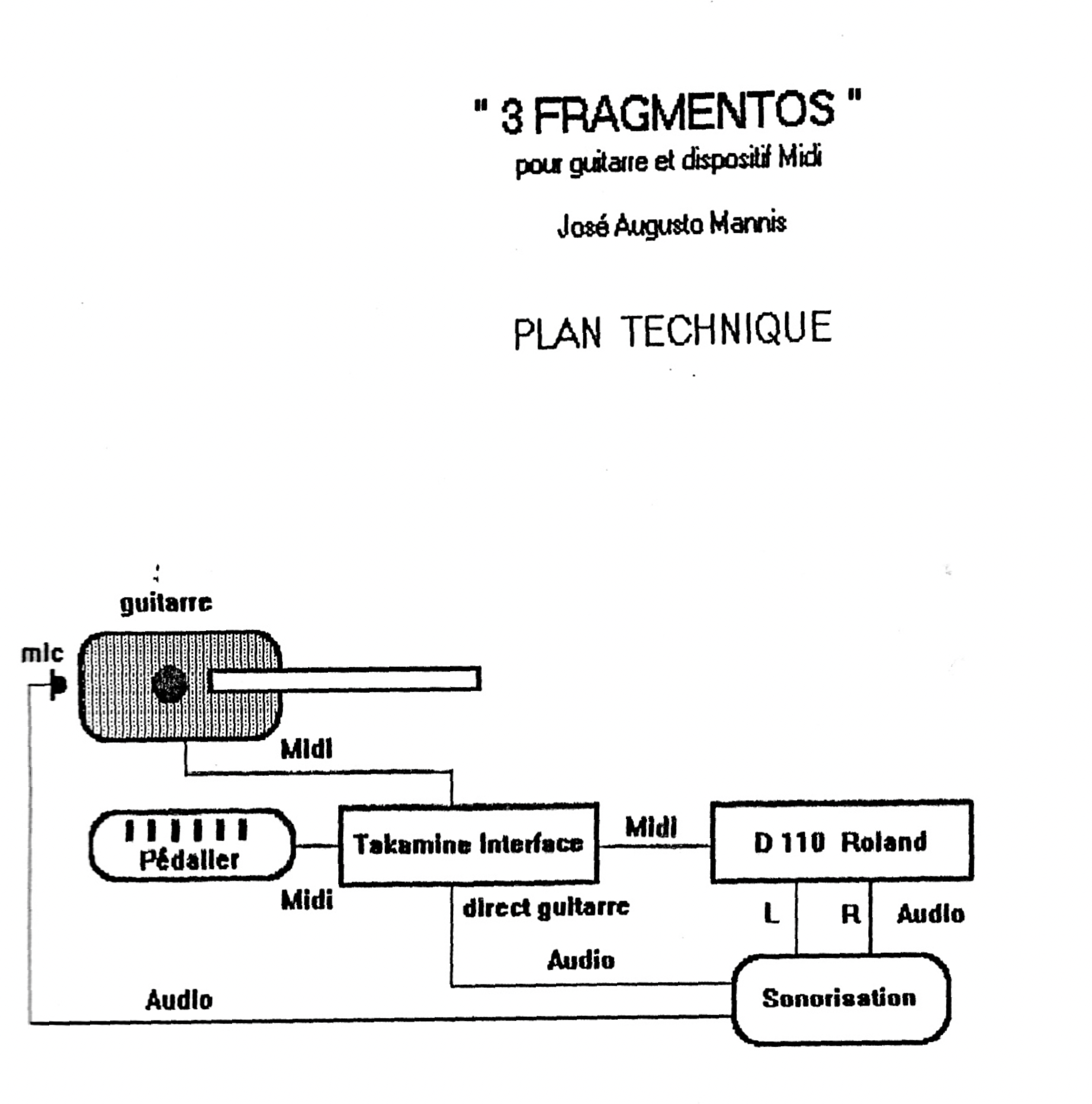
J.A.Mannis, Tres fragmentos, (1992)
The Repertoire and Software-Based Systems
With the integration of software environments—Csound, Max/MSP, and hybrid systems—the nature of the repertoire undergoes a profound transformation. The objective is no longer merely to expand the sound of the guitar, but rather to construct interactive environments in which the instrument becomes part of a more complex ecosystem.
Gabriele Maldonado developed a systematic integration of the guitar with Csound through tools such as Direct Csound and the VMCI system, rigorously exploring the paradigm of interactivity (discussed in detail in Bianchini and Cipriani, Il suono virtuale, p. 493). Works such as Uncontrolled 2 demonstrate how MIDI can function as a language of mediation between gesture and process, rather than as a simple mechanism for translating pitch information.
Of particular interest is also Stefano Petrarca’s Il Giardino Goldbach, which integrates Csound and Max/MSP within a structure in which the guitar does not merely perform “with” the computer, but rather through it. In this case, the digital system does not simply react to instrumental gestures; it actively contributes to the generation and transformation of the musical material itself.
An Evolving Ecosystem
This overview makes it clear that the MIDI guitar repertoire has never been static. Its evolutionary trajectory leads from dedicated hardware systems—characterized by strong physicality and technological constraints—toward increasingly flexible software environments and, ultimately, to contemporary approaches in which MIDI serves not merely to imitate or extend sound, but to define relationships among performer, algorithm, score, and temporal structure.
A useful parallel for understanding this relational dimension can be found in the domain of the piano. The MIDI-controlled Disklavier, explored by composers such as Jean-Claude Risset, demonstrates how the same principle can transform an acoustic instrument into an autonomous interlocutor capable of responding to, anticipating, and storing musical processes. The MIDI guitar participates in the same logic and can therefore be understood not simply as an instrument, but as a system.
The repertoire thus remains inherently open and evolving. Each of the works mentioned would merit a dedicated study of its technical solutions, aesthetic choices, and relationship to the guitar tradition. Nevertheless, a common thread emerges clearly: the progressive transformation of the MIDI guitar from a simple timbral extension into a complex relational system. In this context, compositional practice is no longer concerned solely with notes, articulations, or synthesis processes, but with the design of relationships among instrumental gesture, algorithmic behavior, system response, and the temporal organization of sound.
Works for MIDI Guitar »