MIDI has accompanied—and continues to accompany—virtually the entire spectrum of hardware and software dedicated to electronic and digital music. Its ubiquity is such that the subject cannot be adequately addressed within a few pages; a comprehensive discussion would require a much broader and more systematic treatment.
A consideration particularly relevant to the present study concerns the widespread use of keyboard-based MIDI systems. It can be stated with a reasonable degree of certainty that the majority of MIDI instruments and controllers have been designed around the keyboard interface. At the same time, the relationship between the MIDI keyboard and the piano should not be regarded as self-evident. Rather, it remains an open issue, encompassing both technical and aesthetic implications.
From a technical perspective, the MIDI keyboard inherited many aspects of the piano's organizational logic, including the linear arrangement of pitches and the possibility of controlling multiple simultaneous notes. However, unlike the acoustic piano, the MIDI keyboard functions primarily as an interface for the generation and control of digital events. Its role is not to produce sound directly, but rather to transmit performance data that can be interpreted by synthesizers, software instruments, algorithmic composition systems, and other digital musical environments.
Within the field of algorithmic music, MIDI has therefore assumed a dual function. On the one hand, it serves as a performance interface through which musicians interact with electronic systems; on the other, it operates as a communication protocol capable of linking compositional algorithms, software processes, and sound-generation devices. This dual nature has contributed significantly to the widespread adoption of MIDI as one of the foundational technologies of contemporary digital music practice.
MIDI
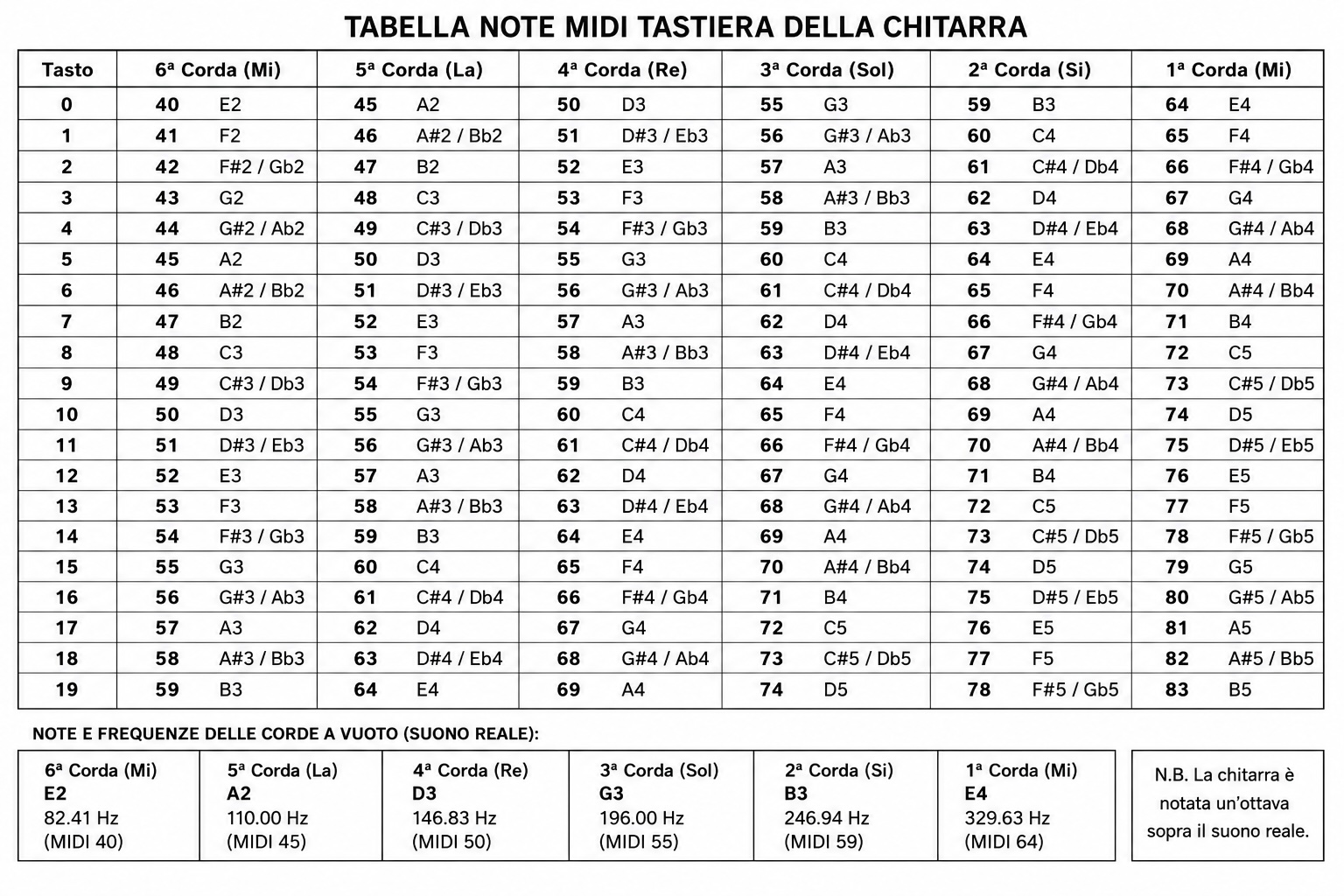
Mapping of the Guitar Fingerboard.
The
so-called weighted keyboard has represented an important point of
convergence between the worlds of traditional and digital instruments, while
still retaining a comparatively limited number of expressive variables when
measured against the complexity of the acoustic instrument. It is precisely
this expressive complexity that has encouraged the development of hybrid
solutions capable of integrating acoustic and digital dimensions within a
single instrument.
A paradigmatic example is Yamaha's Disklavier, an instrument that remains fully acoustic while incorporating a MIDI-controlled mechanical system capable of recording and reproducing performances with complete physical fidelity—including hammer action, pedal movements, and dynamic nuances. Such technology has opened unprecedented possibilities not only for musical performance but also for algorithmic composition and computer-assisted musical processes.
On the software side,
it is also important to acknowledge the introduction of influential tools
such as fiddle~, developed by Miller Puckette. This object
is capable of generating MIDI output from incoming audio signals,
effectively transforming acoustic performance data into MIDI messages. It
represents a particularly significant example of how algorithmic approaches
can interact with the MIDI protocol in flexible and creative ways
(Puckette, Miller. The Theory and Techniques of Electronic Music.
Singapore: World Scientific Publishing, 2007 p. 131).
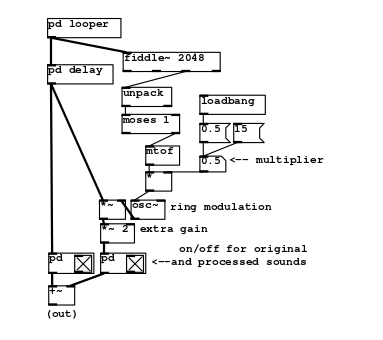
Example to Pure Data M.Puckette, The
The Theory and Techniques of Electronic
(p. 131)
For practical purposes, it may be argued that synthesized sound has been—and continues to be—a structural necessity for algorithmic music, much as the traditional musical instrument has historically been indispensable to compositional and performance practice. The ability to generate, control, and transform sound through formal and computational procedures has made the synthesizer and the MIDI protocol not merely technical tools, but genuine operational environments fully aligned with algorithmic modes of musical thinking.
At the same time, however, the expressive complexity of the acoustic instrument—shaped through centuries of performance practice—remains difficult to reduce to purely digital encoding. It is precisely this tension between formal control and gestural richness that has fostered the development of hybrid systems in which acoustic and computational dimensions coexist and interact with one another.
From this perspective, algorithmic music and contemporary compositional thought should not be understood as a replacement for instrumental tradition, but rather as an expansion of its operational possibilities. On the one hand, algorithmic processes introduce new levels of organization, automation, and transformation of musical material; on the other, instrumental practice continues to provide a perceptual, physical, and expressive complexity that digital technologies constantly seek to integrate, emulate, or extend.
The relationship between algorithmic systems and traditional instruments may therefore be understood not as one of opposition, but of complementarity. Their interaction has contributed to the emergence of new musical paradigms in which computation, sound synthesis, and instrumental performance function as interconnected components of a broader creative ecosystem.