2.2
The RMC Polydrive System (Per-String Architecture and Pitch-to-MIDI
Conversion)
The RMC system is designed to address a problem that conventional piezoelectric pickups do not adequately solve: the mechanical non-uniformity among the six strings of a nylon-string classical guitar. Each string exerts a different vertical force on the saddle, determined by its tension (approximately 50 N for the fourth-string G and approximately 70 N for the first-string E) and by its break angle over the bridge. A shared piezoelectric element responds unevenly to these forces, producing variations in output level and timbre that directly affect the quality of the downstream signal.
The Polydrive solution employs an independent piezoelectric element beneath each of the six strings, mechanically optimized for the specific force exerted by that string and individually adjustable during installation. This per-string balancing is not merely a matter of tonal consistency; it is a prerequisite for accurate pitch-to-MIDI conversion.
A pitch-to-MIDI converter—whether integrated into the guitar itself or housed in an external unit such as a Roland GR or a Fishman TriplePlay—performs most effectively when it receives a clean monophonic signal free from spectral ambiguities. With the Polydrive system, each channel of the hexaphonic output (using the standard Roland/Synthax 13-pin connector) carries only the vibration of a single string, without crosstalk from adjacent strings.
This is the critical point. In systems employing a single shared pickup, the signal generated by one string contaminates those of the others, forcing the converter to interpret a complex and overlapping spectrum. The result is a higher likelihood of tracking errors, false triggering, and increased latency. By isolating each string at the transducer level, the Polydrive architecture provides the converter with six discrete signal streams, significantly improving pitch-detection accuracy and overall system responsiveness.
.
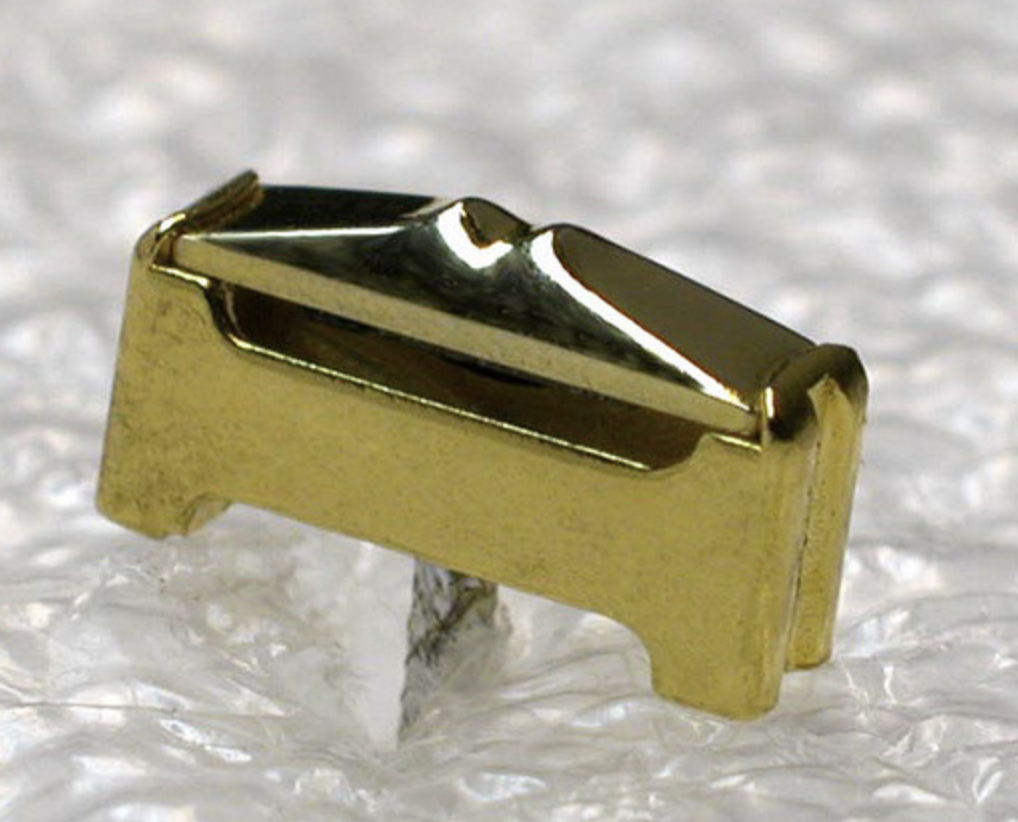
Selletta AGS 14 - 6
With the Polydrive system, the converter receives six separate and independent signals. It detects the onset of each note, identifies its fundamental frequency, and generates the corresponding MIDI message with minimal latency and significantly greater reliability than any monophonic system or single-magnetic-element hexaphonic pickup. This advantage is even more pronounced with nylon strings. Nylon is a viscoelastic material that internally damps higher harmonics, producing an attack transient that is less sharply defined than that of steel strings. The fact that each string is coupled to its own individually calibrated sensing element partially compensates for this characteristic, providing the converter with the clearest possible signal within the physical limitations of the string itself.
The dedicated RMC
preamplifier, featuring an input impedance greater than 10 MΩ, preserves the
full frequency response of the signal from the very lowest frequencies
upward—an essential condition for preventing the fundamental frequencies of
the bass strings from being attenuated before they reach the converter. The
integrated equalization compensates for the characteristic response of the
saddle-mounted piezo elements, but its most important function in this
context is to ensure that all six channels exhibit consistent output levels
and spectral balance. A converter receiving six well-matched signals is less
prone to note-detection errors and delivers a more coherent MIDI response
across the entire range of the instrument:
https://stores.soundislandmusic.com/rmc-acoustic-guitar-ensemble-agt-ags-14-6-saddle-set-and-polydrive-iv-pd403-preamp/