2.1 Classical Guitar with MIDI Pickup
The hexaphonic piezoelectric MIDI pickup does not alter the classical guitar in any of its fundamental structural components. The soundboard, sides, back, neck, nylon strings, 650 mm scale length, and 52 mm nut width remain unchanged. The six individual metal saddles replace the traditional bone saddle, yet they operate according to the same physical principle: transmitting string vibration to the resonant body of the instrument. As a result, traditional performance practice—the nail attack, timbral differentiation between apoyando and tirando, left-hand vibrato, and dynamic control of articulation—remains entirely intact and fully functional. The pickup does not perceive these subtleties as such; it converts them into an electrical signal, but neither eliminates nor diminishes them.
At present, two instruments are commercially available as standard catalog models: the Camps CUT900S MIDI (Barcelona; spruce and ziricote; 650 mm scale length; 52 mm nut width) and the Ramírez Cut 2 with RMC Poly-Drive IV (Madrid; red cedar and rosewood; 650 mm scale length; 50 mm nut width). Both feature a full resonant body, with a cutaway as the only significant geometric departure from the traditional classical guitar design.
These instruments should be regarded as representative examples rather than limitations of the system itself. The RMC pickup is an aftermarket installation that can be fitted by any qualified luthier to an existing classical guitar, regardless of model or price range. The decision of these manufacturers to offer the system as a factory-installed option should therefore be understood as an institutional endorsement rather than a technical boundary.
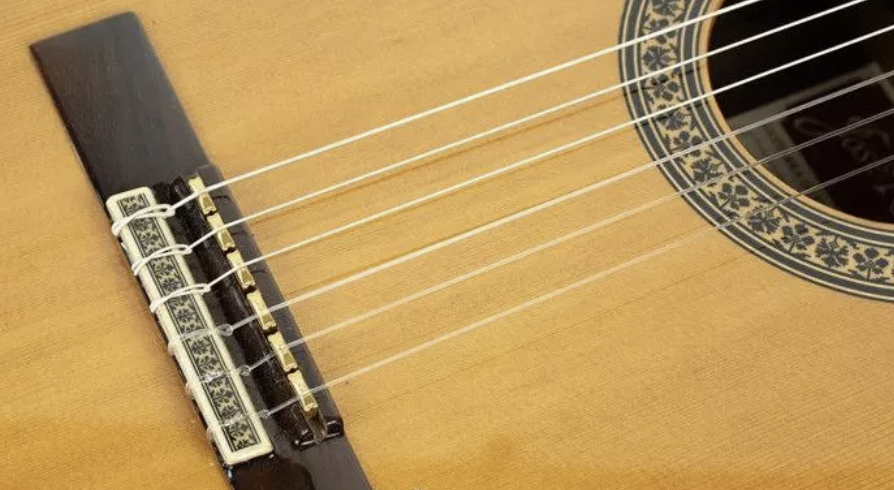
Ramirez Cut 2 with pickup RMC
This structural neutrality constitutes the first key point: digital technology is grafted onto the instrument without transforming it. It is precisely this condition that makes possible the second stage, clearly evident in the performance practices developed between IRCAM and the Paris Conservatoire. Within mixed music, beginning with the pioneering work of Philippe Manoury, classical instruments are not replaced but integrated into real-time interactive systems. Technologies such as Antescofo are specifically designed to track the microvariations of instrumental gesture, adapting the behavior of the electronic system to the performer’s interpretation. In this context, the complexity of traditional instrumental technique is not a limitation but a necessary resource: it is precisely what gives meaning to the interaction between performer and machine.
On these foundations emerges a third level of consideration: the concept of the augmented instrument. The Parisian experience—now explicitly embodied in initiatives such as the Conservatoire augmenté—demonstrates that technological integration does not imply rupture but continuity. The instrument remains unchanged in its historical identity, yet its operational, temporal, and timbral possibilities are expanded. From a theoretical perspective, as Thor Magnusson has suggested, musical instruments embody forms of accumulated knowledge. The addition of a digital system does not erase this structure; rather, it projects it into new contexts.
The classical guitar equipped with a MIDI pickup fits precisely within this framework. It is not a new instrument, but a coherent extension of an existing one. It is precisely this continuity between gesture, tradition, and technology—highlighted by IRCAM’s performance practices—that defines the augmented instrument as a central object of contemporary research, both in the fields of composition and pedagogy.