1.5 The GK-2 Hexaphonic Pickup and the 13-Pin Connector
Among the most significant projects associated with the development of MIDI guitar pickups, the research conducted by Roland Corporation deserves particular attention. The Japanese company played a central role in the development of electronic and electroacoustic musical instruments and contributed substantially to the establishment of the MIDI protocol.
With regard to the guitar, Roland’s research focused almost exclusively on the electric guitar. The company's first external hexaphonic pickup, the GK-1 (1986), employed a 24-pin cable. This configuration was required to accommodate the large number of signals involved, including the six independent audio signals from the strings, the control signals generated by the pickup’s physical controls, and the power supply.
The GK-1 was not, strictly speaking, a MIDI system. Instead, it interfaced directly with Roland’s proprietary guitar synthesizers, such as the GR-100, GR-300, and GR-700. Standard MIDI conversion was possible only through the external GM-70 converter, which translated the analog signals generated by the GK-1 into MIDI messages capable of controlling external sound modules, including those of the Roland MKS series
.
Roland's objective was to develop a system that could be adapted to virtually any electric guitar, representing a significant departure from earlier designs in which the pickup and synthesizer were integrated into dedicated instruments such as the G-303 and G-808.
Building upon this
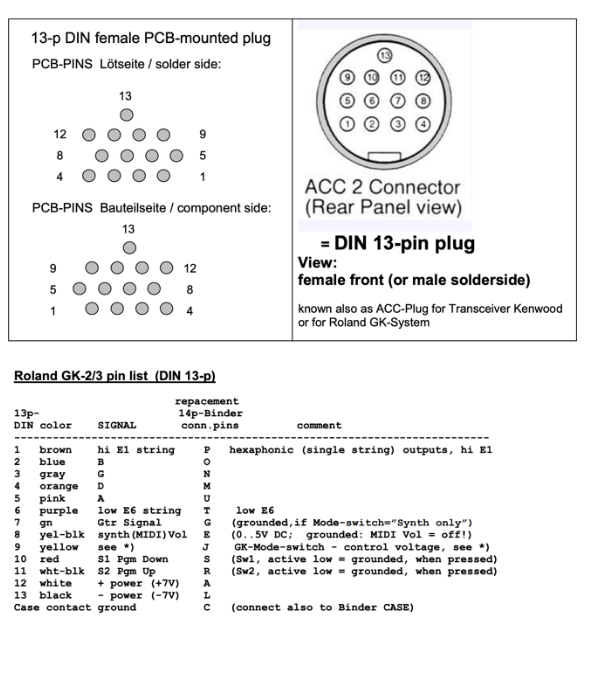
foundation, Roland introduced a more efficient standard: the 13-pin
connector, first implemented with the GK-2 pickup in
1988
[
The
Ultimate Guide to Roland and BOSS GK-Series Divided Pickups - BOSS Articles
].
The physical
connector consists of a circular DIN housing containing thirteen pins
arranged in an asymmetrical rectangular grid rather than the circular
configuration typical of standard DIN connectors, with one pin isolated from
the remaining twelve.
The 13-pin system provides seven audio connections—six dedicated to the individual strings and one carrying the overall guitar signal—together with four control connections and two power-supply lines. The six string signals are transmitted independently, while the conventional guitar output is sent as a mono mix. The control connections accommodate functions such as synthesizer volume adjustment and program-change switching.
Power is supplied through a bipolar ±7 V configuration rather than a simple positive voltage rail. This arrangement allows the analog preamplifiers to operate with symmetrical signal swings, thereby improving overall audio quality. The physical controls mounted on the pickup function as grounding contacts: when activated, they generate signals interpreted by the converter to produce MIDI messages such as Program Change and Control Change commands.
With the introduction of the GK-2, the 13-pin standard became firmly established and subsequently served as the reference interface for converters and guitar synthesizers such as the GR-50 and later models. The system remains in use today; for example, the GK-3 pickup continues to be employed with contemporary products such as the SY-1000 guitar synthesizer.
The 13-pin standard also achieved widespread adoption beyond Roland's original ecosystem. Several manufacturers incorporated it into their own systems, often developing more sophisticated approaches to audio-signal processing. A notable example is Richard McClish's RMC Polydrive system, specifically designed for acoustic and classical guitars equipped with piezoelectric pickups.
The Poly-Drive II, the external preamplifier of the system, receives six independent piezoelectric signals from the guitar through a multipin connector. These signals are individually amplified and processed, including the application of an acoustic-feedback suppression circuit. The processed signals are then transmitted via a standard 13-pin connector to compatible converters. Power may be supplied either by an internal battery or directly through the connector via bipolar ±7 V phantom power.
The final converter receives the six independent analog signals and performs pitch detection, that is, the real-time analysis of the fundamental frequency of each string. The detected pitches are then translated into MIDI messages transmitted over six independent channels. Among the most advanced converters in this field is the Axon system, renowned for its high speed and accuracy, capable of minimizing latency while reliably tracking expressive techniques such as string bending, vibrato, and hammer-ons.
The complete signal chain therefore comprises a dedicated piezoelectric pickup for each string, a multipin connection to the preamplifier, signal processing and transmission through the 13-pin cable, MIDI conversion, and finally output to external devices.
As previously noted, Roland/Boss technology was not originally designed for guitars fitted with nylon strings. Nevertheless, it played a fundamental role in establishing the 13-pin interface as an industry standard, a standard that continues to be employed today in MIDI pickup systems based on piezoelectric transducers for acoustic and classical guitars.
Hexaphonic Pickups and Pitch-to-MIDI Conversion Systems: Yamaha, Blue Chip, and Axon 100
During the early 1990s, the technical challenge of guitar-to-MIDI conversion centered on a fundamental problem: how to capture the signal from each individual string independently and with minimal latency in order to generate reliable MIDI data. Two systems, closely related in their underlying principles yet philosophically distinct in their implementation, emerged as particularly influential: Yamaha’s G1D pickup, developed for use with the G50 converter, and the AIX-101/102 system produced by Blue Chip Music Technology.
The key distinction between these systems did not lie primarily in the pickup hardware itself, but rather in the signal-processing stage that followed.
The Yamaha G50 processes the divided signal using conventional pitch-detection techniques, which require the analysis of complete waveform cycles in order to determine the pitch. As a consequence, latency increases on the lower strings, where the fundamental frequencies are lower and the waveform periods longer.
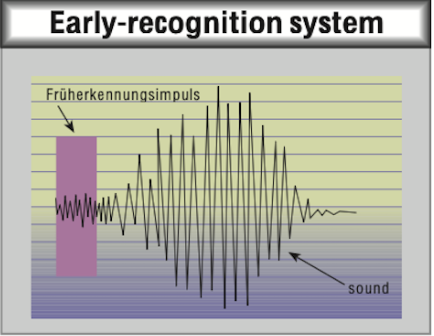
Blue Chip's AXON system introduced a radically different approach through its TER (Transient Early Recognition) technology. Rather than waiting for one or more complete waveform cycles, the system analyzes the attack transient—the brief initial moment when the string is plucked—to estimate the pitch before a full vibration cycle has even occurred. This approach enables pitch recognition within approximately 3 ms, compared with the tens of milliseconds typically required by conventional pitch-detection systems. It is at this point that the two design philosophies diverge decisively.
When Blue Chip transferred production to the German company TerraTec, the technology continued to evolve rather than disappear. The AXON AX-100, and later the AXON AX-100 MkII, became among the most sophisticated MIDI guitar processors ever developed. These systems offered extremely fast tracking, independent string and fretboard-zone splitting, software-based editing capabilities, and an open architecture capable of communicating with any external sound generator through the standard MIDI protocol.
Perhaps the most significant legacy of the AXON system, however, was its compatibility with piezoelectric pickups. No matter how advanced, magnetic pickup systems are inherently limited to ferromagnetic strings and therefore exclude nylon-string instruments, effectively preventing their use with the classical guitar. The AXON's Neural Net processing engine, owing to its ability to analyze transient information, proved sufficiently flexible to process piezoelectric signals as well, despite their markedly different spectral and harmonic characteristics. Although production of the AXON 100 was eventually discontinued by TerraTec around 2010, the technological concepts introduced by the system continued to influence subsequent developments in guitar-MIDI conversion. A key figure is the Hungarian engineer and bassist András Szalay [ info: https://www.panda-audio.com/about ].
It was precisely within this context that the production of RMC (Richard McClish) hexaphonic piezoelectric pickups emerged during the 1990s. These bridge-integrated systems, virtually invisible from the outside and fully compatible with the 13-pin standard, would become a foundational technology for MIDI-equipped classical guitars. Their adoption extended beyond manufacturers such as Godin and other builders of hybrid instruments, establishing an open technological platform upon which much of the repertoire and practice of amplified and synthesized classical guitar would subsequently be developed.
This evolution marked a decisive turning point in the history of guitar synthesis. By enabling reliable pitch-to-MIDI conversion on nylon-string instruments, RMC and compatible conversion systems dramatically expanded the expressive possibilities of the classical guitar, opening new pathways for performance, sound synthesis, and interaction with digital musical environments.