One of the earliest commercial hexaphonic pickup systems designed for interfacing with MIDI technology was developed in Germany by a company specializing in pickup design that remains active today, Shadow Electronics, headquartered in Erlangen. Introduced in 1986, the Shadow GTM 6 represented one of the first practical attempts to integrate the guitar with digital synthesis systems by combining a hexaphonic pickup with a dedicated MIDI converter. The system was adopted by several guitar manufacturers, most notably Ovation, Takamine, and Charvel, thereby contributing to the diffusion of early MIDI-based guitar applications.
From a technical perspective, the defining feature of the system was its use of a piezoelectric transducer. As stated in the device documentation, this type of pickup could be installed on a variety of instruments, including classical, acoustic, and electric guitars, providing a considerable degree of versatility. The adoption of piezoelectric technology was motivated by the need to obtain a rapid and accurate response to string vibrations, a prerequisite for the reliable conversion of the instrument’s signal into MIDI data.
Compared with conventional magnetic pickups, piezoelectric transducers offer a more direct capture of the mechanical vibrations generated by the strings through their interaction with the bridge structure. This characteristic provides a signal with a fast transient response and a broad frequency range, both of which are advantageous for pitch-detection processes. In the context of MIDI conversion, where the accurate and timely identification of the fundamental frequency is essential, these properties contributed significantly to the effectiveness of the GTM 6 system.
The Shadow GTM 6 therefore occupies an important position in the historical development of guitar-synthesis technology, representing a transitional stage between earlier analog pitch-to-voltage systems and the more sophisticated MIDI guitar interfaces that emerged in subsequent decades.
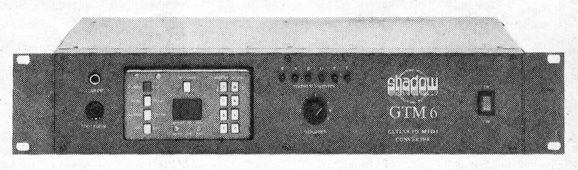
The signal-processing architecture developed by Shadow Electronics for the GTM 6 was particularly significant for its time. The system employed a piezoelectric pickup (based on piezo-ceramic technology) with independent sensing for each string. Within the circuit, each string was assigned to a separate channel, often identified through color coding, and the resulting signals were subsequently routed to a multiplexer. From there, the serialized signal was transmitted via a TRS (Tip–Ring–Sleeve) cable to the MIDI converter and then directed to sound modules or audio amplification systems [ https://www.manualslib.com/manual/834060/Shadow-Sh075.html ].
The design
strategy therefore consisted of implementing a tracking system based on six
piezoelectric pickups arranged in a parallel configuration, whose signals
were aggregated through multiplexing and transmitted in serialized form.
This approach represented one of the earliest effective solutions to the
problem of polyphonic guitar-signal conversion, anticipating later
developments in the field of MIDI guitar controllers.