Pitch-to-MIDI conversion represents one of the major research areas in electronic music and computer music studies: the analysis of an incoming frequency and its identification within a musical system, in this case the equal-tempered tuning system. This problem is closely related to the early stages of sound analysis and to the study of the spectral components of musical signals. Within this framework, the primary objective is to identify a stable parameter that enables the organization and exploitation of the instrument’s expressive and technical versatility. In principle, note recognition necessarily requires signal analysis (pitch detection), which may be achieved through various methods, including the Fast Fourier Transform (FFT), as well as time-domain techniques and adaptive filtering approaches.
Particular relevance in this field is attributed to Japanese research, initially led by Ikutaro Kakehashi [ Ikutaro Kakehashi: The Driving Force Behind MIDI – MIDI.org ] and later by Noboru Suenaga, both of whom focused on the practical problem of note recognition in the guitar.
Early pitch-to-voltage systems addressed this challenge within the analog domain by attempting to convert frequency directly into voltage. However, the complexity of musical signals, characterized by rich harmonic content, soon revealed the limitations of this approach and highlighted the need for more sophisticated methods of sound analysis.
At this stage, pitch-detection techniques derived from signal-processing theory became essential. Operating either in the time domain or in the frequency domain, these methods made it possible to identify the fundamental frequency with significantly greater stability and reliability.
Once a note has been identified, the resulting data can be employed to generate and shape sound through the conventional parameters of sound synthesis, including the ADSR envelope (Attack, Decay, Sustain, Release). The ADSR envelope defines the temporal evolution of a sound’s amplitude: Attack corresponds to the initial rise time, Decay to the transition toward a stable level, Sustain to the maintained amplitude level, and Release to the time required for the sound to fade after the note has ended.
The ADSR envelope therefore constitutes the element that transforms a simple pitch value into an expressive musical event, completing the process that links pitch recognition to sound synthesis. The transition from pitch-to-voltage to pitch-to-MIDI systems represents a significant conceptual simplification: once the problem of note recognition (pitch detection) has been solved, there is no longer any need to convert the detected pitch into an analog control voltage. Instead, it can be translated directly into MIDI data. As a result, the system becomes more flexible, more accurate, and compatible with virtually any digital synthesizer.
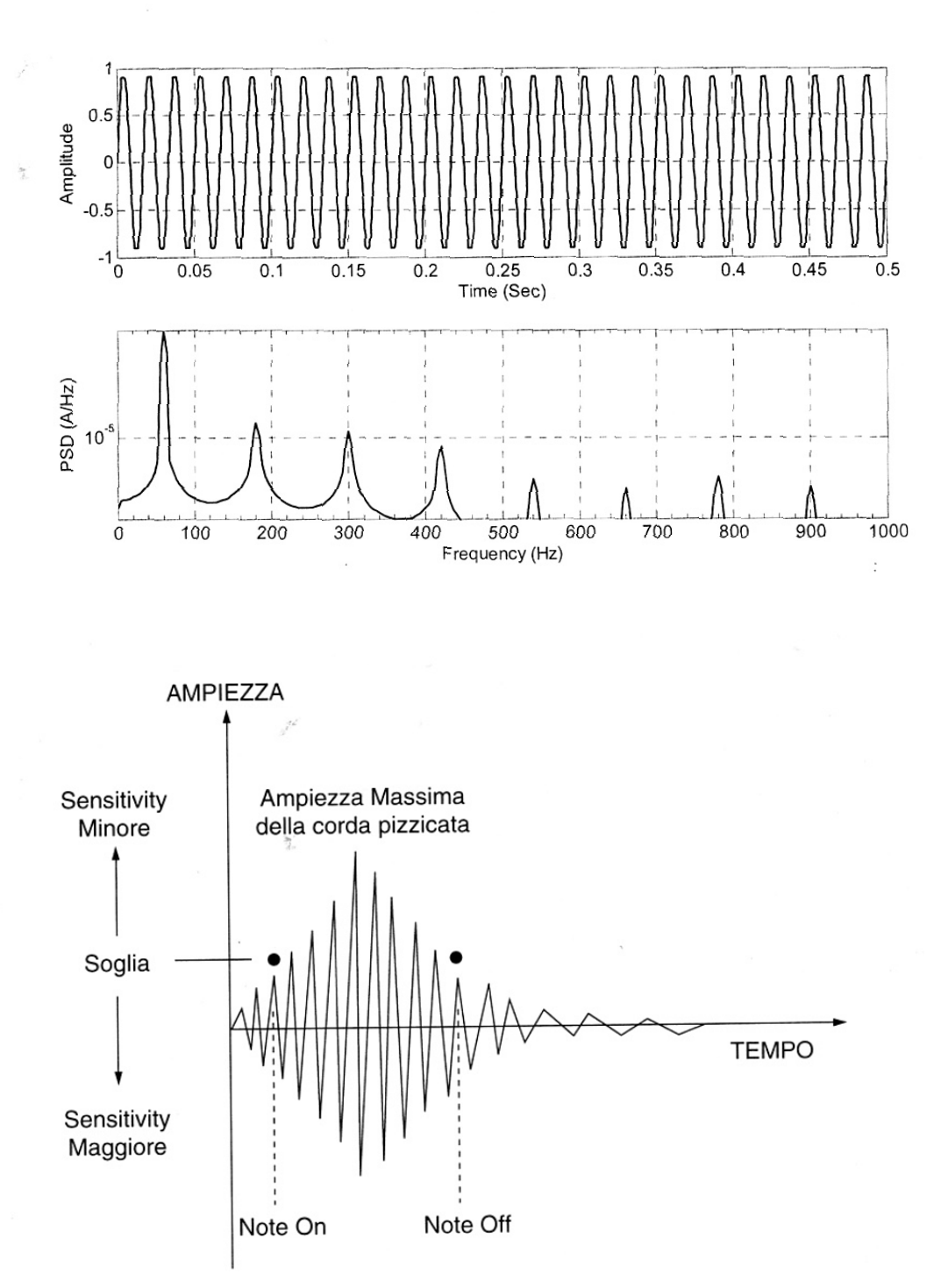
Pitch-to-MIDI (G.Perotti, 1998)
The architecture of a pitch-to-MIDI system is closely related to the internal design of the pickup, both because individual string signals must be isolated and because the acquired signal must be sufficiently clear to enable accurate pitch recognition. In particular, hexaphonic pickups allow each string to be processed independently, reducing inter-string interference and improving the reliability of the conversion process.
It is important, however, to distinguish pitch detection from the analysis of the harmonic components of a signal. Every note produced by the guitar consists of a fundamental frequency, which determines the perceived pitch, accompanied by numerous harmonic partials that define its timbre. Spectral analysis makes it possible to observe and separate these components, but the task of a pitch-to-MIDI system is not their decomposition; rather, it is the correct identification of the fundamental frequency to be translated into MIDI information (G. Perotti, MIDI, p. 150, Jackson Libri, 1998).
In this respect, the pickup also plays a crucial role in determining the spectral quality of the signal transmitted to the conversion system. As illustrated by signal analysis in both the time and frequency domains (see attached figure), each note produced by a vibrating string exhibits a complex waveform that, when decomposed in the frequency domain, reveals the presence of the fundamental frequency and its harmonic overtones. The pickup does not directly participate in the selection of the fundamental frequency—a task that properly belongs to pitch-detection algorithms—but it must ensure the faithful transmission of the signal’s harmonic content while preserving its spectral balance.
An effective transduction system must therefore maintain a sufficiently linear and stable response, avoiding alterations that may emphasize or attenuate specific partials and thereby complicate the identification of the fundamental frequency. In this sense, the quality of both the pickup and its associated electronic circuitry is of critical importance. A clean, well-isolated, and accurately transmitted signal facilitates pitch recognition, reducing interpretation errors, latency, and instability during the conversion process.