1.1 Historical Introduction: The Birth of the Hexaphonic Pickup
The hexaphonic pickup emerged from the idea of achieving independent control over each individual string, with the aim of routing the audio signal separately. Similar to an electronic keyboard, it represents a true six-voice polyphonic system, directly linked to each string. The objective was to trigger a dedicated synthesizer capable of receiving the electrical impulse generated by the instrument.
Unlike the keyboard, where pressing a key simply opens an electrical circuit [C. Roads, Musical Keyboards, p. 645], the guitar system must operate on each individual string and, in its own way, initiate the circuit activation. The first natural solution was to trigger the circuit through magnetic or piezoelectric transduction, detected at the bridge.
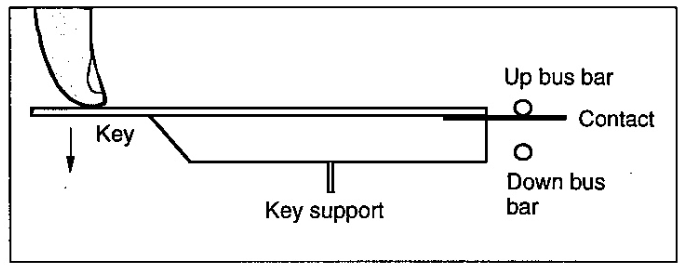
Fig. C.Roads
Thus began the first phase of the hexaphonic pickup, used to connect early synthesizers or sound modules, with the aim of creating a dedicated electroacoustic system using the guitar (classical, electric, or acoustic). Special instruments incorporating this system directly into the body of the instrument were also developed; among the most notable was the SynthAxe [ https://www.synthaxe.org/home ], particularly during the spread of MIDI in the first half of the 1980s.
From 1983 onward, MIDI circuitry began to be installed in digital instruments. The revolution was not only technological but also involved large-scale adoption, while digital electronic research was gradually expanding beyond major research centers.
The 1980s were also the decade in which personal computers began to appear, significantly impacting both music production and the emerging home studio environment. MIDI, with its simple yet effective digital communication protocol, became the bridge connecting different technological chains.
The transition from digital keyboards, such as the famous Yamaha DX7, to a system dedicated to the guitar was now imminent—with one remarkable feature: by assigning one string to each MIDI channel, the guitar was already implementing a concept that would only be formally standardized in 2018 as MPE [ MIDI Polyphonic Expression (MPE) Specification Adopted! – MIDI.org ], while using messages that had already been defined within the original 1983 MIDI protocol [ L.A. Ludovico, MIDI: Una guida al protocollo, alle estensioni e alla programmazione. Milan: Milano University Press, 2021 ].